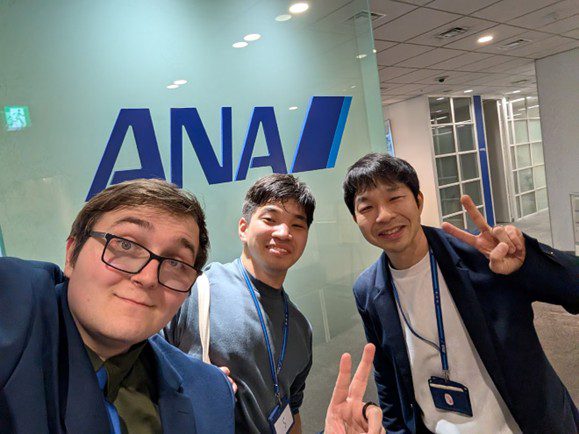
 Scot Nelson standing alongside Universal MaaS Staff at All Nippon Airways. From Left to Right: Scot Nelson (SDC Co-Chair), Eito Inouchi (Universal MaaS Staff), Nobuaki Osawa (Universal MaaS Director). The mood of the image is friendly and light.
 This article is authored by Scot Nelson, Co-Chair of the Seattle Disability Commission. Scot has not received funding from the City of Seattle or the Seattle Disability Commission for travel, research, or for these interviews. The opportunity to interview coincided with research being conducted abroad by the independent Principal Investigator. Consent for this interview was granted by the Seattle Disability Commission as a body.
In February of 2026, I was graciously invited during my travels to sit down with the program director (Nobuaki Osawa) and program staff (Eito Inouchi) of Universal MaaS, a program run by All Nippon Airways that partners with local governments in Japan to make travel more accessible for Disabled people. The goal of my conversation with Osawa-san was to learn about how public and private organizations in a non-American context work to promote and support disability accessibility. You can read more about Universal MaaS on their website. The following include key questions, answers, and takeaways from this conversation.
How would you describe Universal MaaS? I know you work for All Nippon Airways, but I originally found out about Universal MaaS from Asahikawa’s City Website. Is it private, public, or something else?
“The program itself is a partnership that is led by All Nippon Airways, but is a collaboration between ANA, local governments, and Academia. It started out in partnership with Yokosuka City and Yokohama National University in 2019, and now in 2026 we are active in 10 regions with similar local partnerships that span across Private Sector, Public Sector and Academic institutions.”
Universal MaaS offers a few programmatic services, to support people with Disabilities:
The Universal Access Map and the One Stop Travel Support service . As of January 2026, the ‘one stop travel support’ program has partnerships between three airlines, ten railway companies, three bus systems, eight taxi companies and one hundred fifty-seven accommodation facilities throughout Japan. Ultimately, Universal MaaS is a well-networked program that is led by industry (ANA) while maintaining public, nonprofit, and academic support as lateral partners in the regions they service.
How does Universal MaaS work with people who have different kinds of disabilities?
“Let me show you the homepage for our website. We have two different services – One Stop Travel Support and the Universal Access Map.”
For the Universal Access Map, Osawa-San walked me through what it looks like. Using ANA’s own GIS API, it projects a map on my screen like what you might see in Google Maps. The first big difference I noticed is that many of the streets were different colors.
“Those green areas are street crossings. That other color is data from the wheelchair log.”
Data is provided through one of the partners of the Universal MaaS program, WheeLog!, which provides user-submitted wheelchair data that helps track and indicate which routes are the most accessible for people with mobility disabilities. It is integrated into the Universal MaaS Universal Access Map, which means that people who are planning their travel have easy access to seeing which routes are possible ahead of time.
“When using the One Stop Travel Support service, you let services like train operators or bus drivers know how to be prepared.”
Osawa-san pulled up the GUI for the One Stop Travel Support application, where a user can input many different kinds of disabilities, which included visual disorders, sensory disorders, dementia, language disorders and developmental disorders among other options, including ‘other invisible disorder’. Moving through the options, you choose how many passengers you need, modes of transit that you are interested in using, and the exact location you need. I then asked a follow-up of Osawa-san about how he and his team came up with the disability options.
“When my child was born, my grandmother was unable to come see her. There were a lot of problems with travel, and a lot of questions she had that made her hesitant to be able to travel to Tokyo to meet her great-grandchild. To help her, I had to talk to multiple companies and explain her situation to the bus, to the taxi, and to the airline. She was able to see the smiling face of her great-granddaughter in real life, and so it became my mission to help create a world where anyone can travel by connecting these modes of travel. The disability options come from real barriers that people face, real reasons why people are hesitant to travel.”
In 2010, Asahikawa, one of the cities that is partnered with Universal MaaS had a population that was 26.6% people aged 65 or above. In 2023, this number is closer to 35.0% of the population. Aging is tied to an increase in likelihood to become disabled, as well as being a reason why people are hesitant to travel. They could become sick, or they may have to wait in the cold for the bus, or they may feel like they are bothering others by expressing a need for help. Thoughts like these tend to be easier for younger people to brush off, but what could be a minor inconvenience to someone able-bodied or young may be enough to prevent an elder or a Disabled person from even leaving the house.
How did Universal MaaS start working with local governments? Were there any difficulties with implementation of Universal MaaS at a local level that were unexpected? For example, a problem we have heard about in Seattle is that emergency services sometimes do not have the capacity to bring people’s mobility assistance tools, so they are left where emergency services pick somebody up.
“To answer the first part of this question, research already being done at the University had the same aim as the project proposed within ANA. The partnership with the local government came because they also had the same aim.”
You can find the launch announcement here. (Requires Page Translator)
“There are always difficulties when building infrastructure, and things that we weren’t expecting. One example of this would be how wheelchair users sometimes have difficulty navigating Tenji Blocks (Braille Blocks).”
Tenji Blocks, or Braille Blocks are tactile surfaces that are used by people who are blind or low-sight who use canes to determine direction and road crossings.
“Our team has learned a lot about how people with disabilities navigate the world, and our biggest takeaway is to use universal design principles to allow people to choose how they want to move around. When problems come up, we create solutions that have multiple options.”
Right now, there is a big push in the US, and in Seattle towards “Digital Accessibility”. How does Universal MaaS ensure that people can access services digitally?
“We learn a lot from others. For example, in our video explaining Universal MaaS, we found to best support people who want to learn more that are blind or low-sight to use a method like this Extended Audio Description Video on Youtube to have visual elements explained through audio. We use and follow the WCAG (Web Content Accessibility Guidelines) when designing our web content, as well.”
The Web Content Accessibility Guidelines are a set of internationally-recognized standards based on decades of feedback from Disabled people around the globe that help guide best practices for developing web content.
How do you work with partners such as local businesses and local governments to spread awareness of and help them work towards creating better outcomes for disabled people? Are there ever moments where you feel like Universal MaaS has changed the way businesses approach Accessibility?
“Yes, and It’s not just transportation. Elevators, restrooms and other features are tracked on the Accessibility Map. Businesses other than those that are involved in transportation are encouraged to think more about their accessibility and how they can serve more people. When people know that they can be served without barriers, their hesitation to try going somewhere goes away.”
Osawa-san and I then talked a little bit about the differences between the US and Japan, and where Universal MaaS’s approach represents a proactivity that we in the City of Seattle may learn how to layer services from.
In the United States, the Americans with Disabilities Act is the main source of law for requirements around disability accessibility. In Japan, there are some laws that govern disability access, but which tend to be far less demanding on business owners and private entities. Whenever disability access is guaranteed by people making legal complaints and businesses being legally required to make changes, this leaves out people whose voices may be marginalized, those who may have a harder time communicating, and situations that are rare enough that there are few complaints made. The approach Universal MaaS takes to creating accessibility relies less on “how did this go wrong?” and instead relies on “how can we create new openings?”
Universal MaaS creates incentives for businesses and institutions to increase the number of people who can travel to realize mutual benefit, and a proactive approach to promoting accessibility, rather than a reactive or protective approach.
“The way America protects people with disabilities is admirable. In Japan, people really want to help people in need, but don’t always know how. If we can help people to communicate their needs clearly, it’s only natural that people would respond to help them.”
Both legal protections and positively building towards more access are necessary, and there isn’t a “better” or “worse”. Instead, my sense from talking with Osawa-san is that developing proactive strategies alongside protective strategies makes it easier for businesses to adapt to change, and for the public to get used to seeing Disability Access as valuable and necessary.
Thank you very much for inviting me to visit your office and talk about these issues and your perspective. I’m impressed by the program and have learned a lot!
Osawa-san and I were able to spend the last few minutes of our interview chatting about Seattle, the Mariners, and the work of the Seattle Disability Commission. I am glad to have met him and Inouchi-san, and glad to have learned from Universal MaaS strategies for layering proactive approaches to supporting Disabled residents.
The most obvious lesson is also the most impactful for me – that Disability is one of the most universal aspects of life, and one of the most universal challenges to work through. This also means that there are an endless number of allies in the struggle to create a more accessible world, and I am happy to have met some halfway across the world.