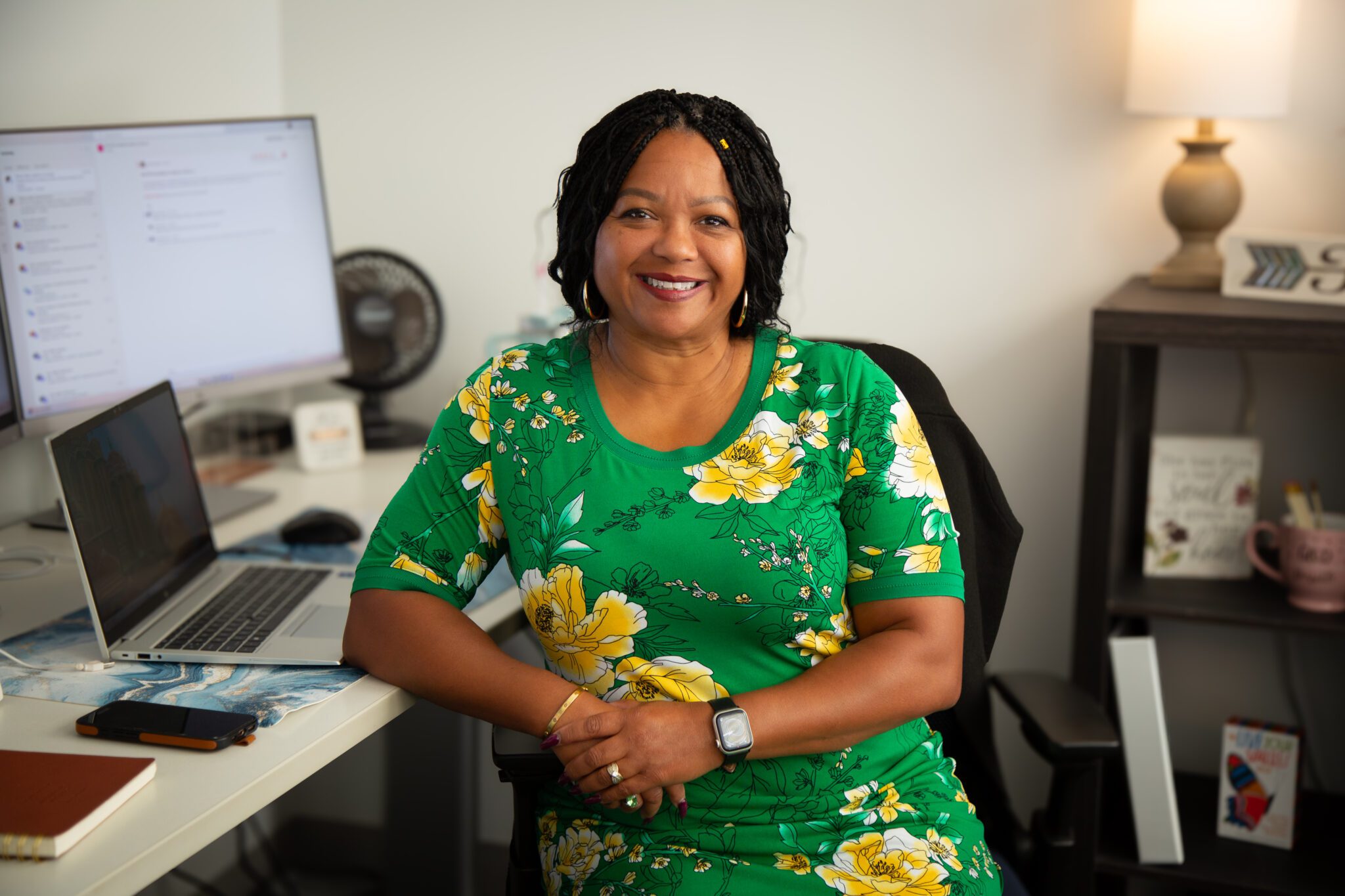
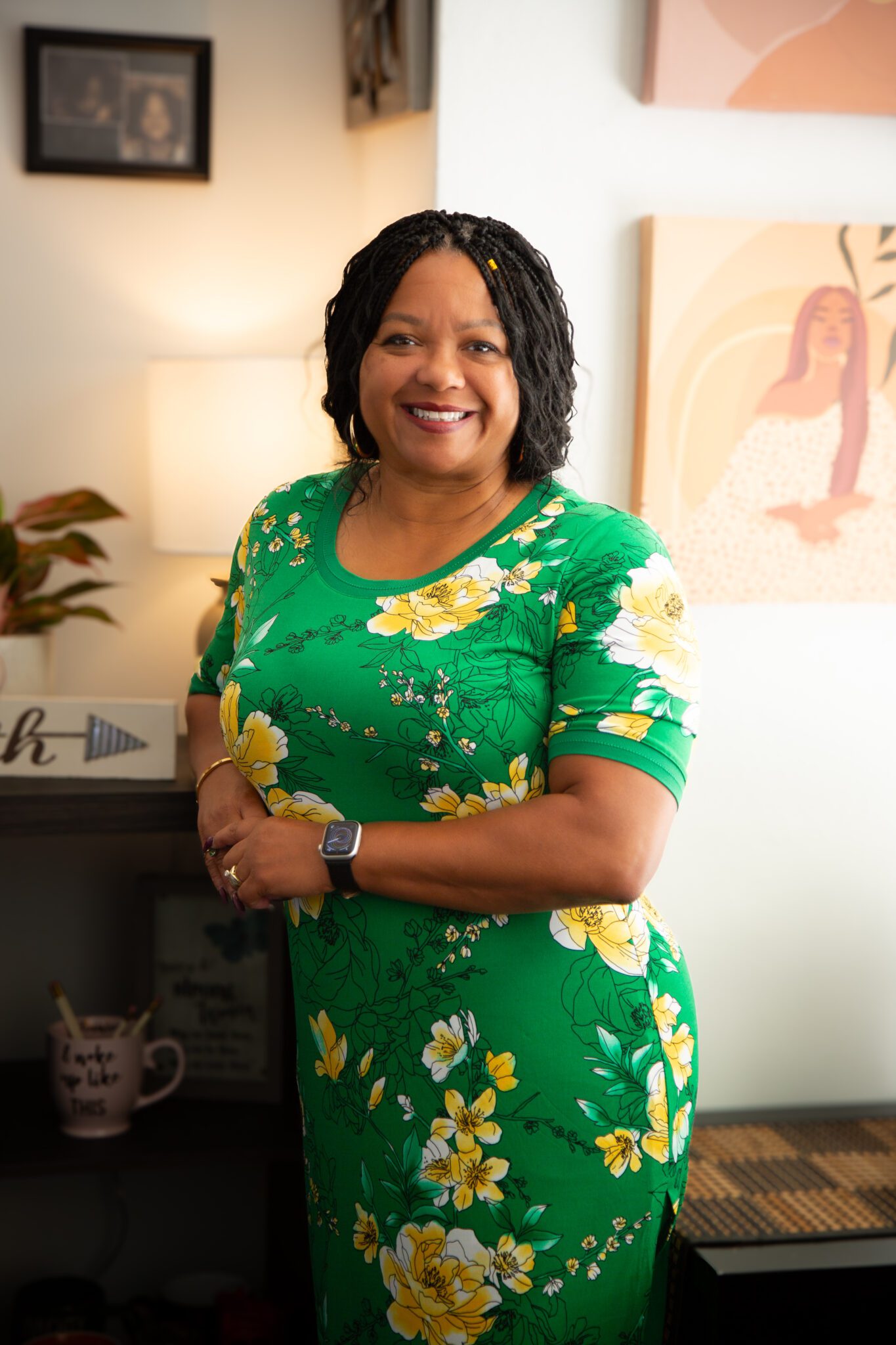
 Denise Daniels sitting in her office at the Seattle Office for Civil Rights.
 The Seattle Office for Civil Rights (SOCR) recently welcomed Denise Daniels (she/her) as the new director of the department’s Race and Social Justice (RSJ) Division. The Race and Social Justice Initiative (RSJI) is the City of Seattle’s commitment to end institutional racism in City government and achieve racial equity. Established in 2004, RSJI was officially codified as law in 2023, and celebrated its twenty-year anniversary in 2024.
As RSJ Director, Denise leads a growing team of equity practitioners who work to apply a racial justice framework and embed racial equity and social justice principles into the City’s programs, budgets, and culture. Building on the work of civil rights movement and ongoing community-led efforts in Seattle to confront racism, the RSJ Division aims to organize for racial justice, capacity building, foundational knowledge about race, and personal accountability to advancing equity.
Denise is a visionary, award-winning leader whose career reflects both courage and innovation in driving equity, diversity, and inclusion. With deep experience across multiple school districts and regional initiatives, she has led with conviction and skill to bring about lasting, systemic change that improves lives.
Throughout her career, Denise has been a catalyst for environments creating spaces where people feel not just included, but truly valued, seen, and heard. She has worked alongside superintendents, executives, and educators across the state, designing professional development that not only educates but transforms — sparking culture shifts and creating sustainable impact. Her leadership was pivotal in guiding the Auburn School District to become only the third district in Washington to adopt a racial equity policy — one grounded in best practices for procedures and an implementation plan that continues to shape the district today.
Can you tell us about your journey and what brought you to SOCR?
I have been doing equity work in educational settings for the last 13 years. It became especially important to me once I understood the lack of equitable access that families had for their children—particularly families who were not English speakers, families with children who have special needs, and those who didn’t necessarily know how to advocate or what resources were available to them.
I am a parent of five African American boys and two girls – and even in my journey as an involved parent with formal education, I really struggled at times. I saw the inequities that affected my own children and when I began working for school districts, I saw similar disparities impacting many families. Supporting families in accessing available resources became deeply important to me.
Who we place in front of our children matters. I’ve led racial equity training with families, leaders, and educators across Washington—guiding participants to engage in critical self-reflection and accountability, build trust and relationships, deepen foundational knowledge about race, and actively challenge systemic racism. When the opportunity at the City of Seattle arose, it felt like a natural next step.
What does challenging racism and other forms of oppression look like within institutions? How can we challenge these systems authentically?
We have to be collaborative. We have to work together. Too often, resources are stretched thin. We need to come together to ensure we have a cohesive approach and a collective goal. We have shared responsibilities and accountabilities—and we must be willing to hold other parts of the city accountable as well.
We also can’t be afraid to say what needs to be said. It’s difficult to talk about institutional racism, engage in critical self-reflection, and confront internal biases. But unless we name racism for what it is and begin to dismantle it—by understanding how it came to be and how our systems and institutions continue to uphold it—we won’t move forward. We have to interrogate these structures and commit to tearing them down.
This work is not easy. People tend to hold onto familiar systems, especially when those systems benefit them. But we must examine the systems that don’t benefit all of us and critically explore how to transform them to equitably serve everyone. It’s not about taking from one group to give to another—it’s about creating opportunity for all.
To authentically challenge racism and other forms of systemic oppression, we must do the uncomfortable and challenging work of coming together and committing to the hard work of undoing.
What does civil rights mean to you?
Civil rights will always matter and will always be necessary. To me, civil rights mean that every human being has the right and opportunity to be successful—whatever that looks like for them. They should have access to resources and live in an environment where they feel safe and valued. They should have the confidence to use their voice and trust that it will be seen, heard, and respected. I believe it also means that, as a society, we are citizens who have a say in our environments, our cities, and our country.
What drives your passion for equity and inclusion?
As an African American woman, I have personally faced equity challenges. Learning to navigate those challenges has not always been easy. I’ve been fortunate to serve in roles where, often, I was the first person who looks like me to hold that position. It’s important to me to be that kind of person—so others can see that opportunities exist.
Children of color don’t often see reflections of themselves in leadership roles or government spaces. It’s crucial that they have opportunities to envision themselves in those positions. I am committed to sharing influence to empower communities and deeply believe that equity is not only about access, but also about opportunity, support, and transformation.
That belief has been a key driver of my passion for equity and inclusion. Creating space for diverse perspectives allows us to challenge and overcome barriers—and to grow.
What are you most excited about in your role as RSJ’s Director?
I’m excited to expand partnerships and really unpack what RSJI has been. I’m looking forward to building a strong, growing team where we will work together to shift the direction RSJI is heading, create opportunities for access, and build a city that fosters healing and belonging. I love Seattle—my children have gone to school here, and my husband has owned businesses here. It’s a diverse city that is rapidly growing and I’m excited for the opportunity to support its growth, contribute to a thriving community, and build on the long history of racial justice in the city.
Looking ahead, what is your vision for the future of the Race and Social Justice Initiative at the City of Seattle?
I envision the RSJ Division at SOCR as a responsive and innovative team—one that generates bold, fresh ideas and shares them across departments to break down barriers and work together toward a collective goal of ending institutional racism. I want RSJI to serve as a thought partner and a challenger of the status quo. I believe we must examine systems critically and be willing to challenge them, encouraging folks to grow, embrace change, and create culture shifts. I want our division to uplift the work of our strategic partnerships, including other departments, groups, and individuals within the City of Seattle who are committed to advancing racial and social justice.